Samoo’s Next 50 Years : Reinventing Itself as a “Space Lifecycle” Partner
In its 50th anniversary year, Samoo Architects & Engineers is on the verge of setting a new all-time record for order intake.
The milestone finds the firm at its peak, as both a living chronicle of Korean architecture and the country’s largest architecture firm.
Yet the message CEO Sohn Chang-kyu has set out for the anniversary is not self-congratulation over past achievements. It is a call for fundamental transformation. He defines Samoo’s first 50 years as the “first half” and has put “client-centric business” front and center as the key theme that will carry the firm through the “second half.”
In an interview with Daehan Kyungje on the 30th of last month, Sohn said, “Until now, every architecture firm has run on a feast-or-famine model built around one-off projects and man-hours. When there’s no work, we fret about the drought; when there’s too much, we scramble for people. All the while, we have stayed stuck in the passive role of an order-taker. That is precisely why our scope of practice keeps shrinking.” He added, “Samoo’s next mission at 50 is clear: rather than getting trapped in one-off projects,
we will become a partner that thinks in terms of the client’s entire business lifecycle.”
◇ Beyond the Drawings: Proactive “Space Lifecycle” Solutions
The space solutions business Samoo is building under Sohn goes beyond the traditional role of a design firm that simply produces drawings and hands them over. When a client sets out to build a headquarters or plan a space, Samoo proactively offers a “space lifecycle solution” covering the entire journey, from early-stage feasibility studies conducted before the client even commissions the project to operations after completion.
“Samoo’s first 50 years were a process of drawing on past successes to identify businesses with long-term viability,” he said. “Now we need to shift our perspective. We have to look at things from the client’s point of view, not from the standpoint of products or projects. We must be able to offer differentiated services before the client asks for them.”
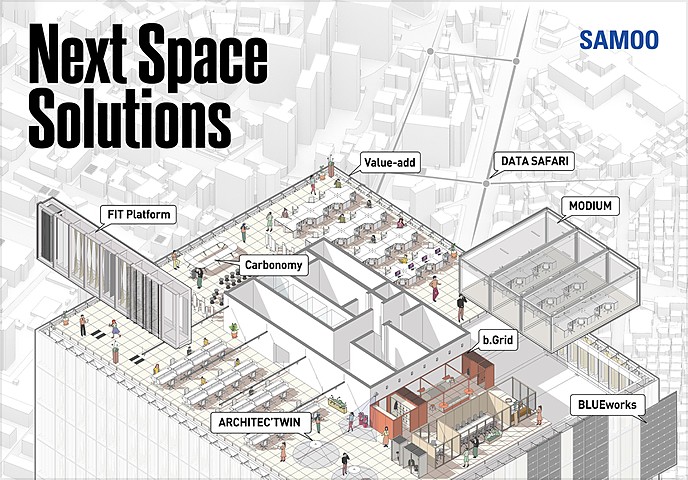
Built around the client’s entire business lifecycle, the space solutions business Sohn envisions unfolds on several fronts. At the outset of a project, Samoo analyzes a wide range of big data, including credit card transaction data, foot traffic and transportation flows,
to recommend the optimal location and size of the space before the client even asks. In the design and construction phases that follow, it takes the initiative in proposing modular construction for projects where schedule compression is critical. For companies focused on ESG management, it proposes smart building envelopes and eco-friendly systems that create tailored environments.
The solutions continue after completion. Samoo provides carbon accounting reports that quantify emissions and identify ways to reduce them, helping improve the building’s sustainability. It also uses occupancy sensing technology to analyze space utilization in detail, then recommends efficient reconfiguration and remodeling. Its modular furniture solutions, in particular, allow customized spaces to be created quickly, adapting to organizational changes or new ways of working without major construction. Going a step further, Samoo uses digital twin technology to simulate future headquarters expansion in a virtual environment, offering end-to-end support from planning through operation to future growth.
“We must evolve from passive order-takers into ‘sellers’ who proactively bring value propositions to the market,” he said. “Just as the seemingly unbreakable 10-second barrier in the 100-meter dash was eventually broken, I believe that once we create and deliver a new level of service in the design market, it will spread across the entire industry.”
Sohn’s pragmatic management philosophy puts solving clients’ business problems ahead of the glamour of signature architecture.
It is the product of his 35 years at Samoo.
When he joined Samoo in 1991, the young Sohn Chang-kyu harbored the idealistic aspirations typical of architecture students.
He planned to gain hands-on experience at a large firm, then open his own atelier and build a career as a design architect with his own body of work. In 1990, he married the woman he had met in college, and when he became a licensed architect in 1995, that dream seemed within reach.
But life was not so kind. The very year he joined the firm, his father died suddenly. The joy of landing a job was short-lived. Still in his twenties, he became the sole breadwinner for a family of five, including his mother, a younger brother serving in the military,
a younger sibling still in school, and his wife. Above all else, he needed a stable monthly paycheck to support them.
To make matters worse, the 1997 Asian financial crisis, known in Korea as the “IMF crisis,” hit like a tidal wave. With the entire market frozen, striking out on his own would have been reckless. On the day he shelved his dream of independence out of duty to his family, he decided to stay at Samoo and kept asking himself a fundamental question:
“Architecture must begin with the client’s needs, but as problems grow larger and more complex, there is a limit to the answers an individual or a small firm can offer. How, then, can I contribute to the company’s survival and growth from within a large organization, and help answer the enormous demands of society and the planet?”
This shift in mindset was the starting point that would eventually lead him to the CEO’s chair. He set aside his ego as an individual designer and came to see design as problem-solving for the organization, its clients and society.